AI is quietly planning the media. Creators are taking the budgets. And AI assistants are starting to do the shopping, learning what your brand stands for from everything it says. The brands that win say one thing, the same way, everywhere. This is the companion to my conversation with Justin Lebbon: the evidence, the charts and the tools. Copy anything you like.
The creator playbookWatch with chaptersShane Skillen · CEO, Hotspex
Justin asked me for one word: are creators building brands or breaking them? I said breaking. Not because creators are bad. Most creator content wins the attention and the brand doesn't get the credit. Here's the evidence and the brief I'd use to flip it.
US creator ad spend in 2025 (up 26%, about four times total media growth), with $44B projected for 2026. (IAB)
Influencers Unilever says it works with, as it moves about half its marketing budget to social. (Marketing Week, The Drum)
Of Canadians 16+ say they follow influencers or creators, down from 41% the year before. (Leger DGTL 2026)
Having the creator say the brand name out loud lifts brand linkage by 22 percentile points on average. Only 49% of creator content does it. (Kantar Creator Game Plan, via Hello Partner)
Of brand memory lift is explained by engagement. Creative quality explains 54.6%. Likes don't tell you if it worked. (WPP Media × System1 × TikTok)
Creator ads with strong early branding delivered 2.3 times the brand awareness lift and 3 times the brand image lift. Sound in the first 2 seconds lifted awareness 191%. (System1 × TikTok)
Why it happens: platforms reward attention, and what wins leans fun, warm and familiar. That's the creator's personality, not the brand's. One off-brand post is a missed rep. Hundreds pulling different ways is a blurry brand that still looks great on the reports.
Canadians would rather hear about a brand's products from the brand than from creators. Even 16 to 24 year olds pick the brand, just: 36% to 33%. (Leger DGTL 2026)
For people highly attached to a brand, an influencer deal can feel like a broken promise. It lowered their purchase intent and willingness to pay. (Bentley, Rajagopal & Kulow, Journal of Consumer Psychology, 2024)
A smaller creator in the right world can beat a bigger one where the brand feels bolted on (WPP Media × System1 × TikTok). 53% of Canadians who follow creators prefer smaller, community creators, and 79% prefer personal content to paid partnerships. (Leger)
Two findings look like they fight until you split a cue from a pitch. Put 2 to 4 brand codes in the first 2 seconds: audio and visual together roughly double early recognition, yet fewer than 5% of creator ads use sound that early (Creator Effectiveness Playbook). But lead with the product, benefit or brand message too early and the 25% view rate drops 44% on Instagram and TikTok (Billion Dollar Boy × DAIVID, 5,000 creator assets). Colour, sound and shape go first. The message comes later, in the creator's own voice.
AI shopping assistants learn what your product does from what people post about it. Meta's Muse agent launched in September. If 300 creators give 300 different reasons to believe, the assistant has less to go on when it decides who to recommend. Say the reason to believe the same way, right after the product name, every time.
Brand: [name] The feeling we own: [2-3 emotions, e.g. confident, warm, a bit cheeky. Not the tagline] Where your world and ours overlap: [the emotions you already bring that fit ours] Brand codes in the first 2 seconds (pick 2-4, sound and sight): [logo in context, sound, character, colour, line] Say the product name, then our reason to believe in these exact words: [one line] What's yours: the idea, the format, the voice and the humour What we won't do: [off-brand topics, competitors, claims we can't make] How we'll judge it: brand codes early, attention held through the post, reason to believe said right How you get paid: base fee, plus a bonus when the post hits all three. Paid media goes behind the posts that do.
I don't think so. Brand trackers can tag creator content and show what it does to the brand. When brands see it eroding long-term value, that's the wake-up call to move money back to the channels that build it. The best setup is a big shared TV moment as the tentpole, with creators reaching the people TV can't and riffing on the same codes. Kantar's advice for 2026: move from isolated creator executions to long-term creative platforms. (Kantar) The TV evidence
Watch it on the episode page. The audio on Apple Podcasts and Spotify is our first, longer take of the same conversation, so the times below match the video.
Every figure links to its source. Our own research is labelled as ours.
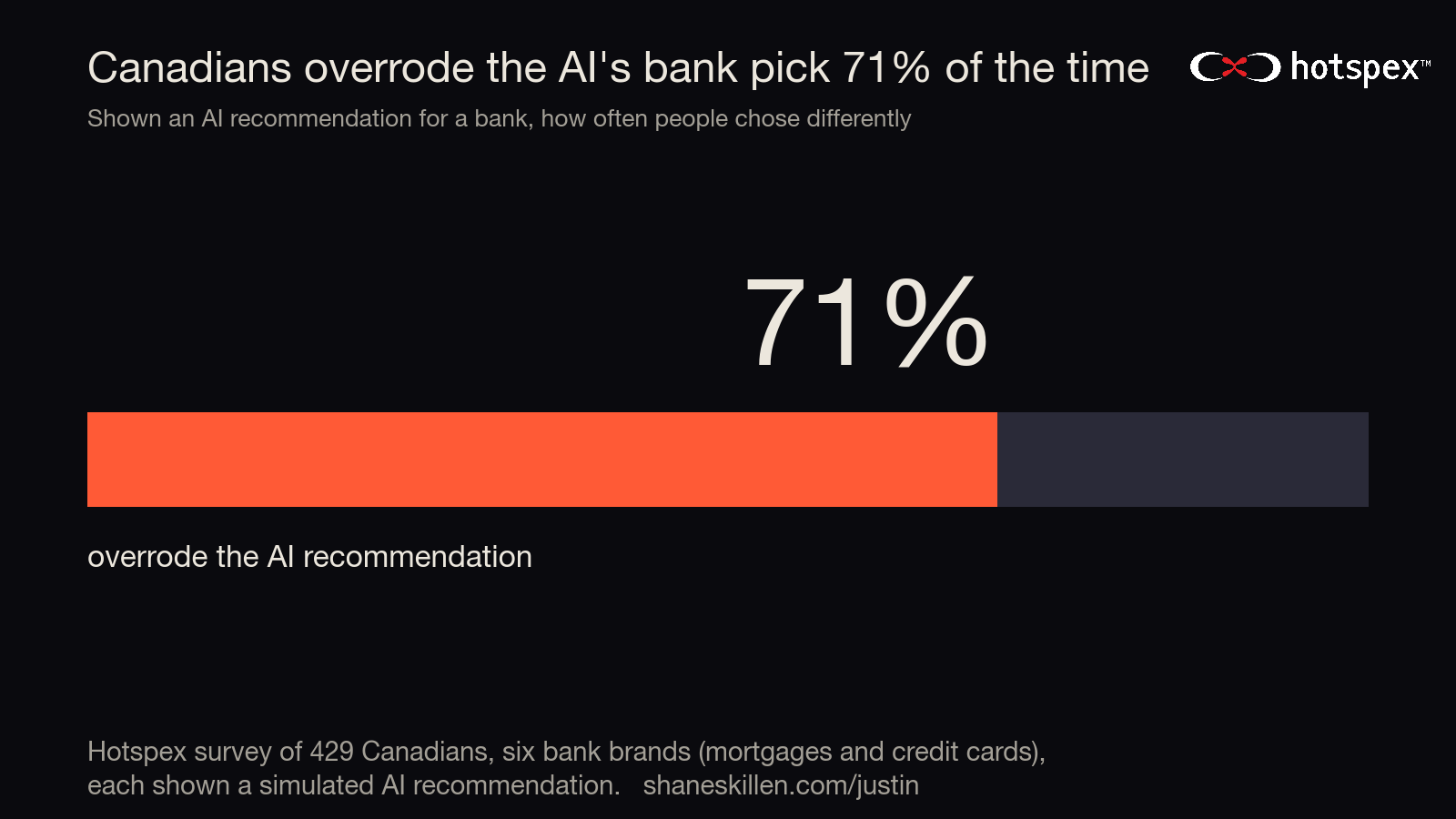
Canadians were shown an AI's bank recommendation and overrode it 71% of the time. People still choose the brand they trust. Brands nobody feels strongly about are at the mercy of the model.
Hotspex survey of 429 Canadians, six bank brands, mortgages and credit cards.
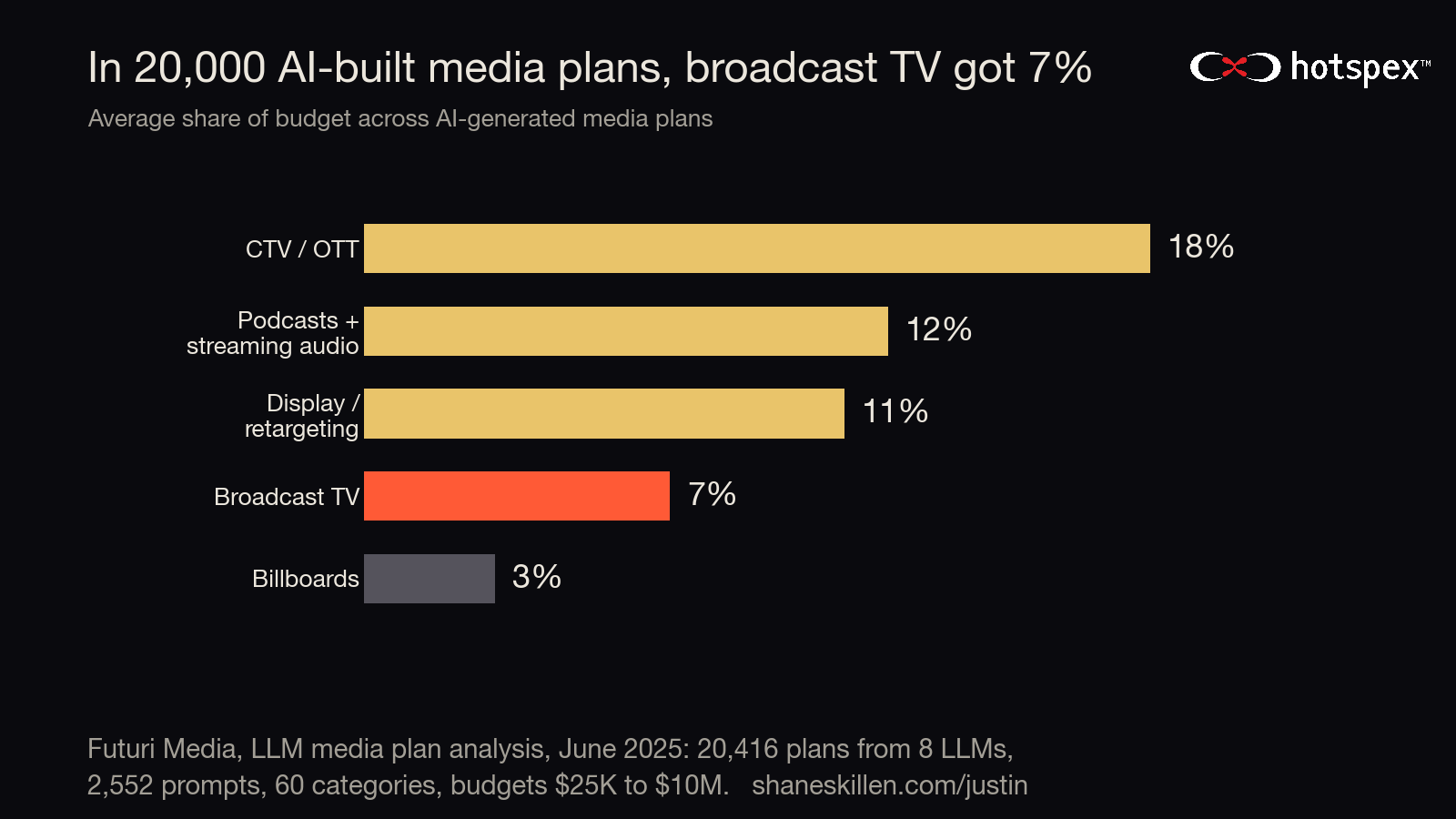
Broadcast TV's average share of budget across 20,416 media plans built by eight AI models, against 18% for CTV and streaming. Switching models swung a channel by up to 12 points.
Futuri Media (June 2025). More
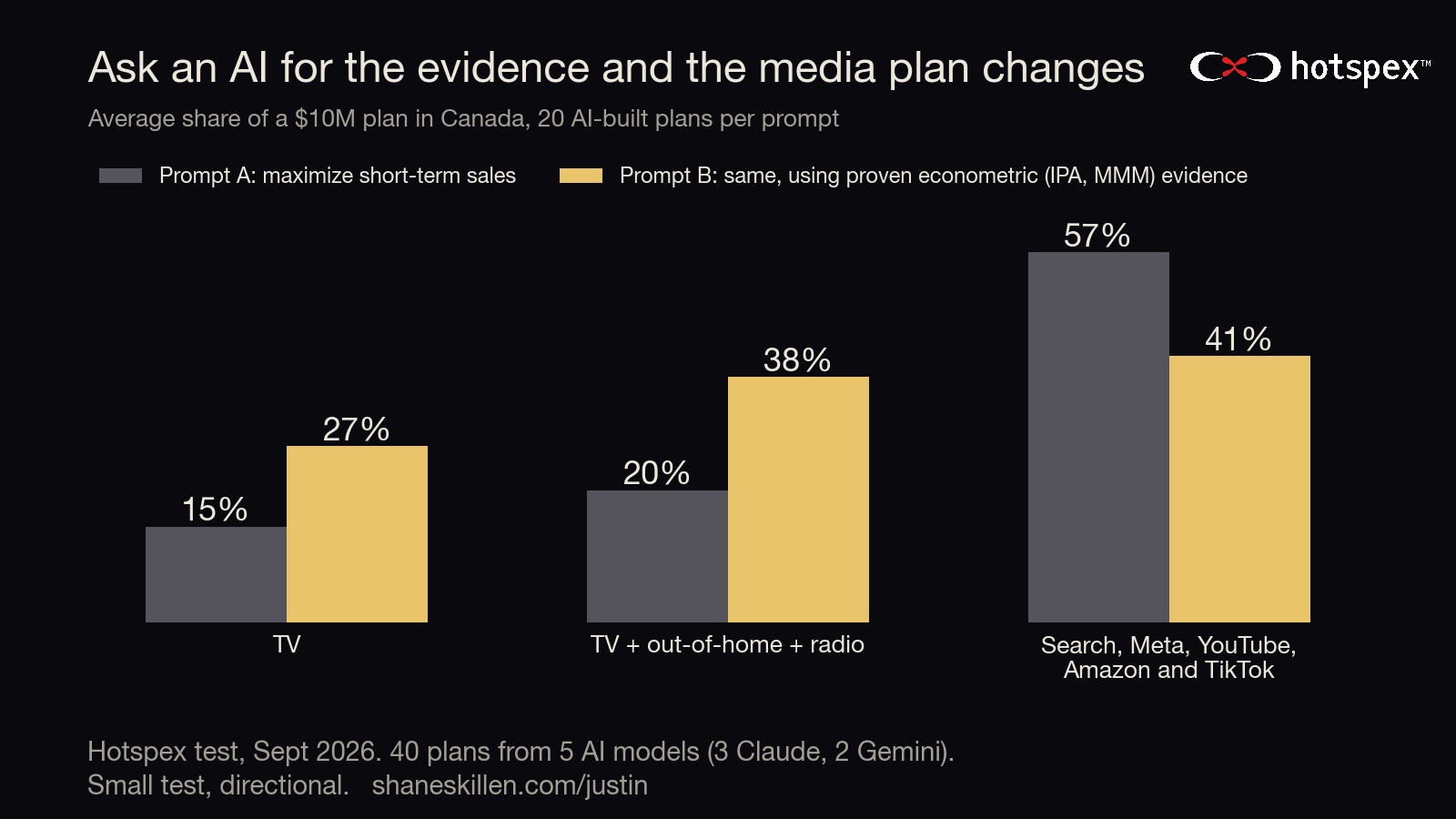
TV, out-of-home and radio's share of an AI-built $10M plan when the prompt asked for proven econometric evidence. The big platforms fell from 57% to 41%.
Hotspex test, Sept 2026. 40 plans. See the prompts
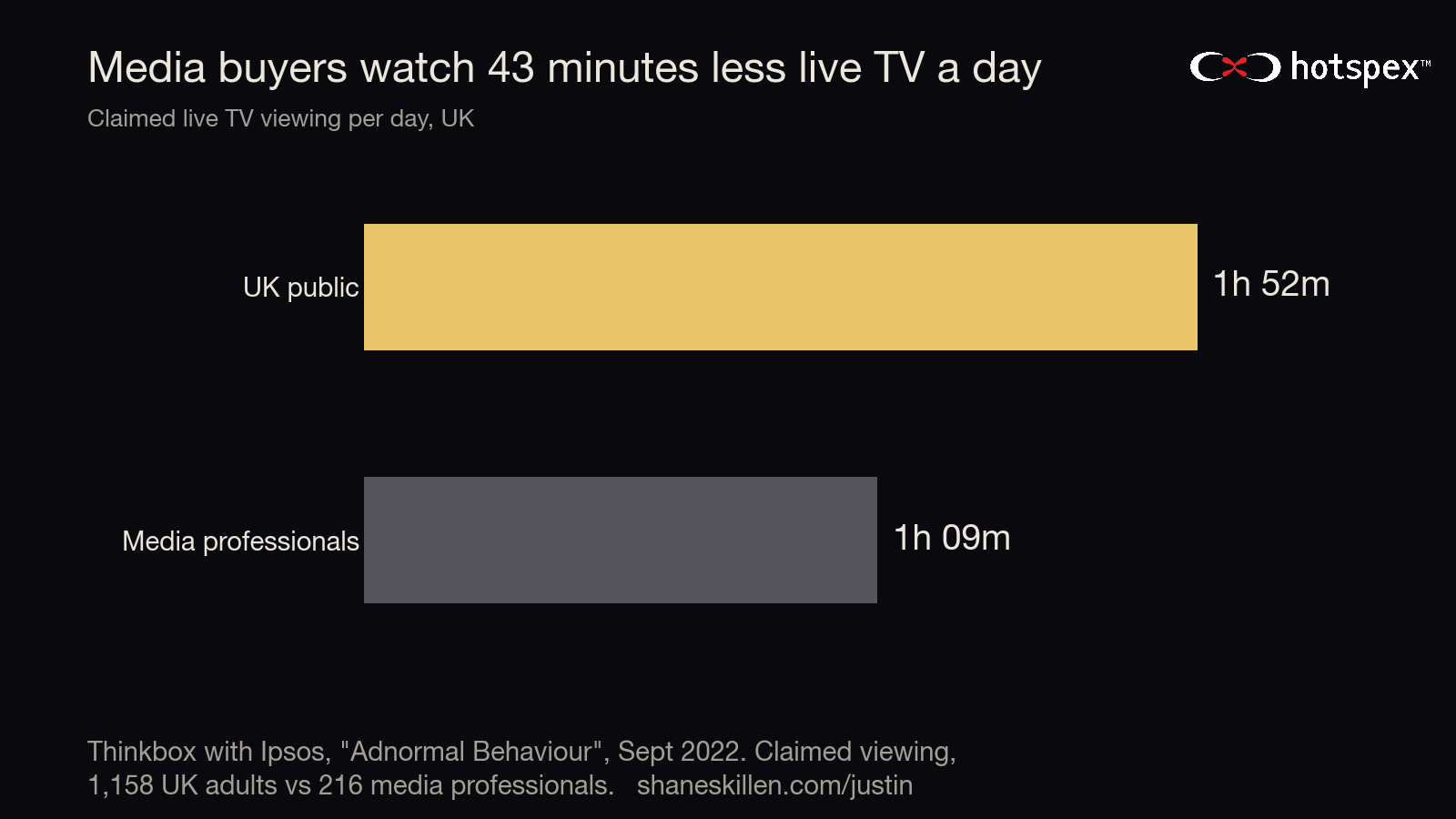
Media professionals say they watch 43 minutes less live TV a day than the public (1h 09m vs 1h 52m), and are 153% more likely to use TikTok.
Thinkbox with Ipsos, Adnormal Behaviour (UK, 2022)
Of advertising's profit arrives after the first 13 weeks. A 13-week dashboard never sees most of it. TV delivers 54.7% of advertising's full profit from 43.6% of the spend.
Thinkbox, Profit Ability 2 (April 2024)
Meta starts adding "product browsing" to your existing Facebook and Instagram ads unless you opt out, so buyers can shop a catalog on Meta instead of visiting your site.
PPC Land (Oct 2026). How to opt out
We asked five AI models (Google Gemini and Anthropic Claude) to build a $10M media plan in Canada, 20 times with each prompt. The only thing we added: use proven econometric evidence. Now ask what prompt your agency's AI got.
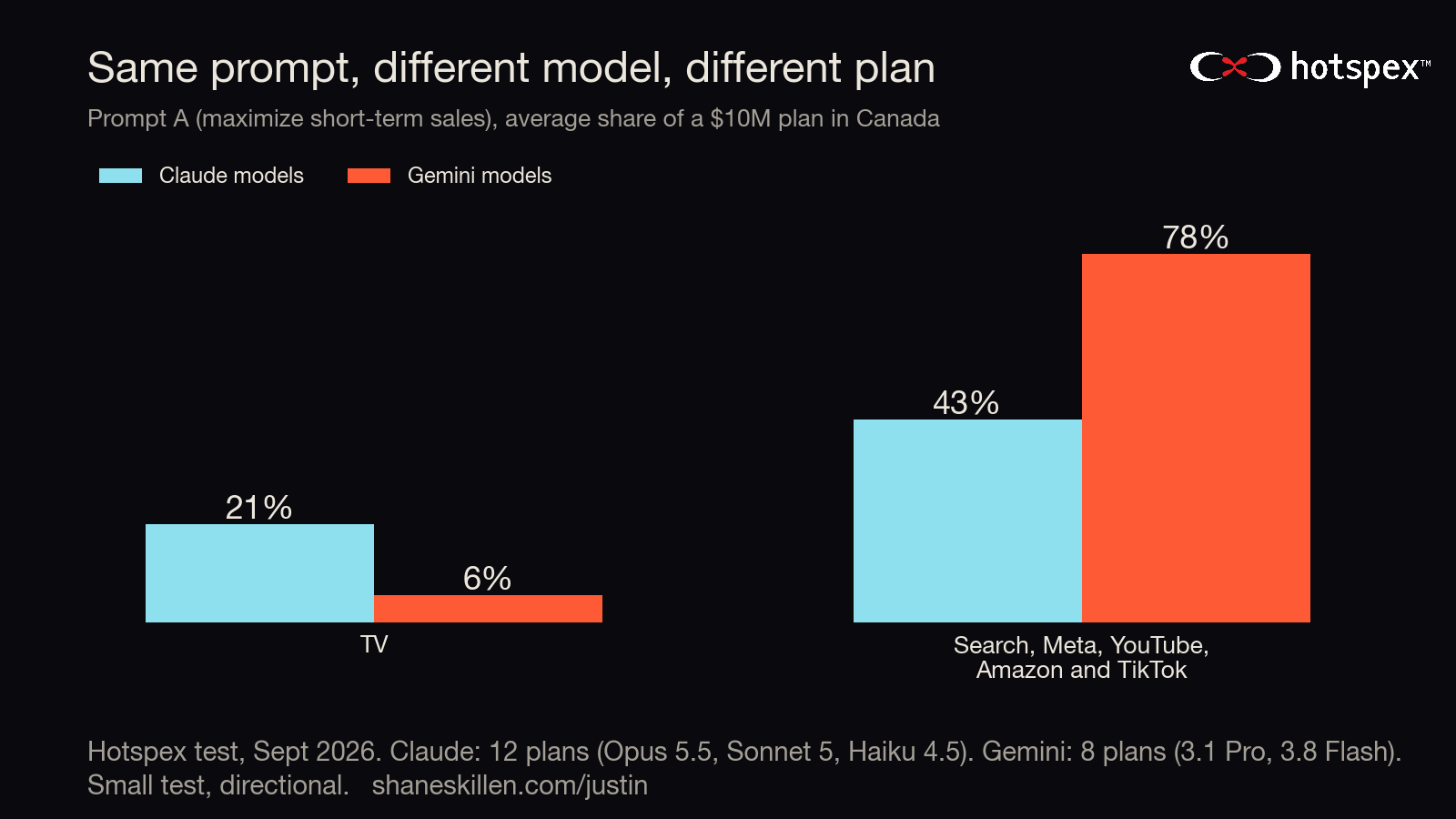
Hotspex test, September 2026. 40 plans from 5 models (Claude Opus 5.5, Sonnet 5, Haiku 4.5; Gemini 3.1 Pro, 3.8 Flash), average share of budget. Small test: read it as directional. A second run with shorter "maximize my ROI" prompts and no market named pointed the same way: TV went from 12% to 32%.
Claude: 12 plans. Gemini: 8 plans. These are closed models, so nobody outside can see why they differ. That's the reason to ask how your plan was built.
Base the plan on proven long-term econometric evidence (IPA effectiveness data and independent marketing mix models), not only short-term attributed returns. Show the split between brand building and sales activation, and explain the long-term effect of each.
The models learn from what's published, and far more is published about digital's short-term returns than about long-term effectiveness. And these are closed models: nobody outside the company can see how they're tuned. Treat any AI plan as a first draft and ask it for the evidence.
Futuri, which sells AI tools to broadcasters, asked eight AI models to build media plans across 2,552 scenarios: 60 business categories, local to national, budgets from $25K to $10M. 20,416 plans later, the pattern was clear. Read the full report and their write-up.

Run the same five prompts in ChatGPT, Gemini, Claude and Meta AI every month. Log whether you're named, where you rank and which words describe you. If you're not in the answer, that's a brand problem, not an SEO problem.
1. What's the best [category] brand for [main need]? 2. Which [category] brand would you trust most for [job], and why? 3. I'm shopping for [product] under [price]. What should I buy? 4. Compare [your brand] with [main competitor]. 5. Describe [your brand] in three words.
WPP Media's CEO has said no human will touch a media plan within five years (Digiday, Aug 2025). Maybe. Until then, someone on your side should audit what the machine recommends. Your agency isn't the villain. It gets graded on short-term results, so change what it's graded on.
1. How was this plan built, and which AI tools touched it? 2. What evidence sits behind the split: our marketing mix model, IPA econometrics, or platform-reported returns? 3. Rerun it with the evidence prompt and show us both versions side by side. 4. Have you read the Futuri study, and how do you check your AI tools for the same bias?
Copy these, then edit the numbers in brackets.
Platform-reported ROAS and attributed conversions are reporting metrics, not decision metrics. Any budget increase above [10]% on an automated campaign needs an incrementality read: a holdout or lift test, or the independent MMM.
Brand-term exclusions are on in all Performance Max campaigns. Existing customers are excluded or capped in Meta sales campaigns using a rolling [180]-day purchaser list. The agency confirms these settings in writing every quarter.
At least one holdout test per quarter on the largest automated line. Test design is agreed before launch. Results are shared in full, including tests that show no lift.
The marketing mix model is run by a third party paid by the advertiser. Platform-built tools can be inputs, not the referee.
Brand and activation budgets are set separately at planning. Automated campaigns cannot draw from the brand budget without written sign-off from [the CMO].
Cost, delivery and quality metrics are pass/fail hygiene. [X]% of the agency incentive is tied to incremental sales and brand strength. No incentive is tied to platform-reported ROAS.
Why it matters: when eBay switched off its brand search ads, almost all the clicks came back through free search (Blake, Nosko & Tadelis, Econometrica 2015).
Plenty of people still watch TV. The people deciding where the money goes mostly don't, so the feed feels like the whole world to them. That's the site I promised Justin on air: Thinkbox's Adnormal Behaviour.


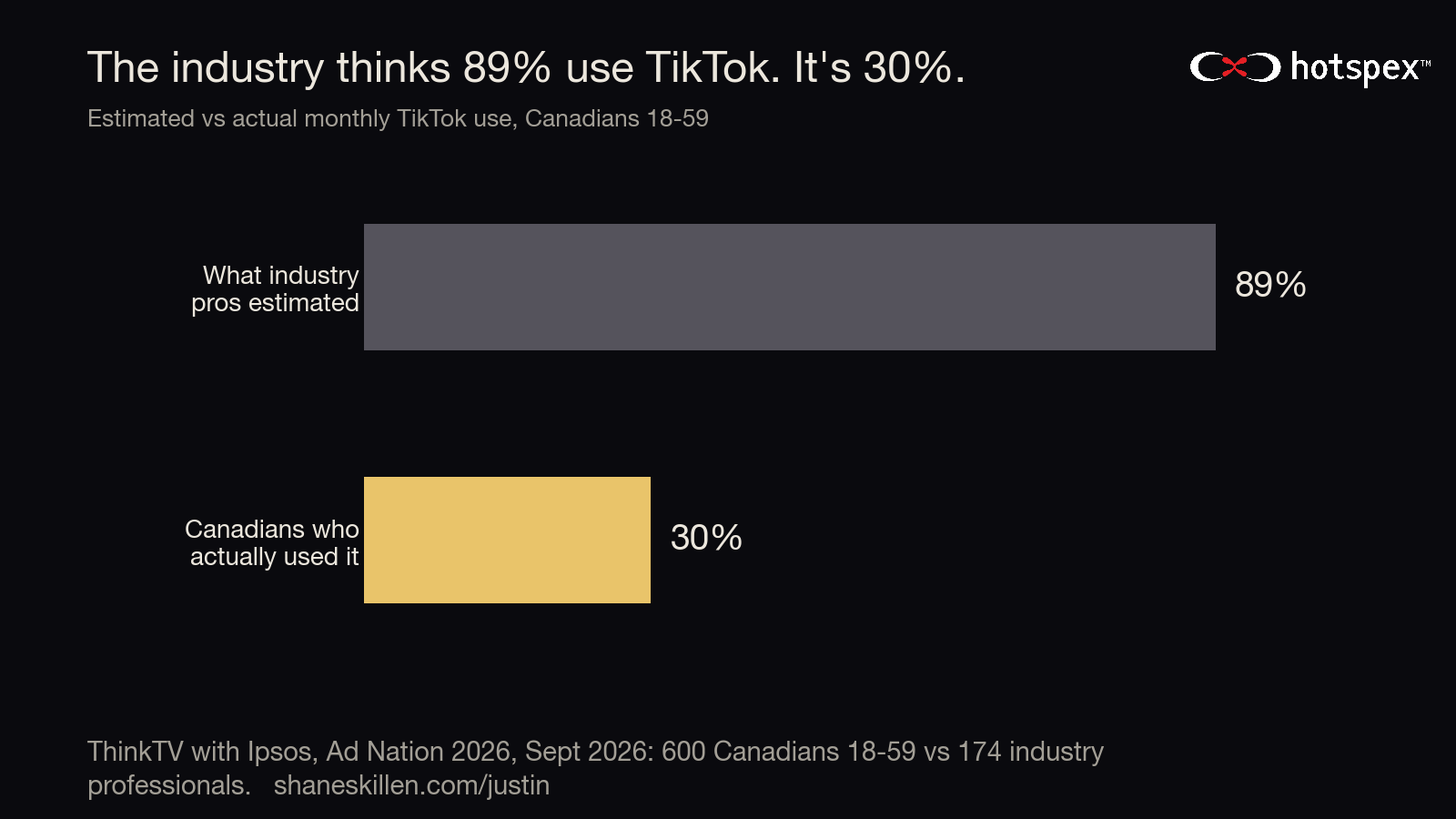
ThinkTV ran the same check in Canada this year. Industry professionals guessed 89% of Canadians 18 to 59 use TikTok every month. The real number was 30%. (Ad Nation 2026)
The models only know what's published. In our small test, asking for the econometric evidence nearly doubled the share going to TV, out-of-home and radio. Put your effectiveness studies on open pages, in plain language, where AI can read them.
Most of advertising's profit lands after 13 weeks, and TV does more than its share of that work. Pair audience data with an independent read of what the ad did for the brand, so your best work shows up on the advertiser's page.
A big shared TV moment gives creators something to build on, and keeps the brand codes on screen when they do. Creators reach the people TV can't. They work best added to the tentpole, not instead of it.
Starting October 28, Meta adds "product browsing" to your existing ads unless you opt out. When someone taps your ad, Meta can send them to a catalog shopping view on Facebook or Instagram instead of your site, and take credit for the sale.
Meta says advertisers in its August test saw 3% more conversions. It hasn't said what counted as a conversion, and it hasn't published a help page on the change. (PPC Land)
For Justin's write-up and anyone else. Each chart carries its source on it.
The studies behind the episode and my September talk to Canadian advertisers, in one place.